Commercial Roof Coatings in Bakersfield: Extend Roof Life and Cut Cooling Costs
Commercial roof coatings in Bakersfield extend roof life, cut cooling costs, and ensure Title 24 compliance. Learn ROI strategies for your property today.
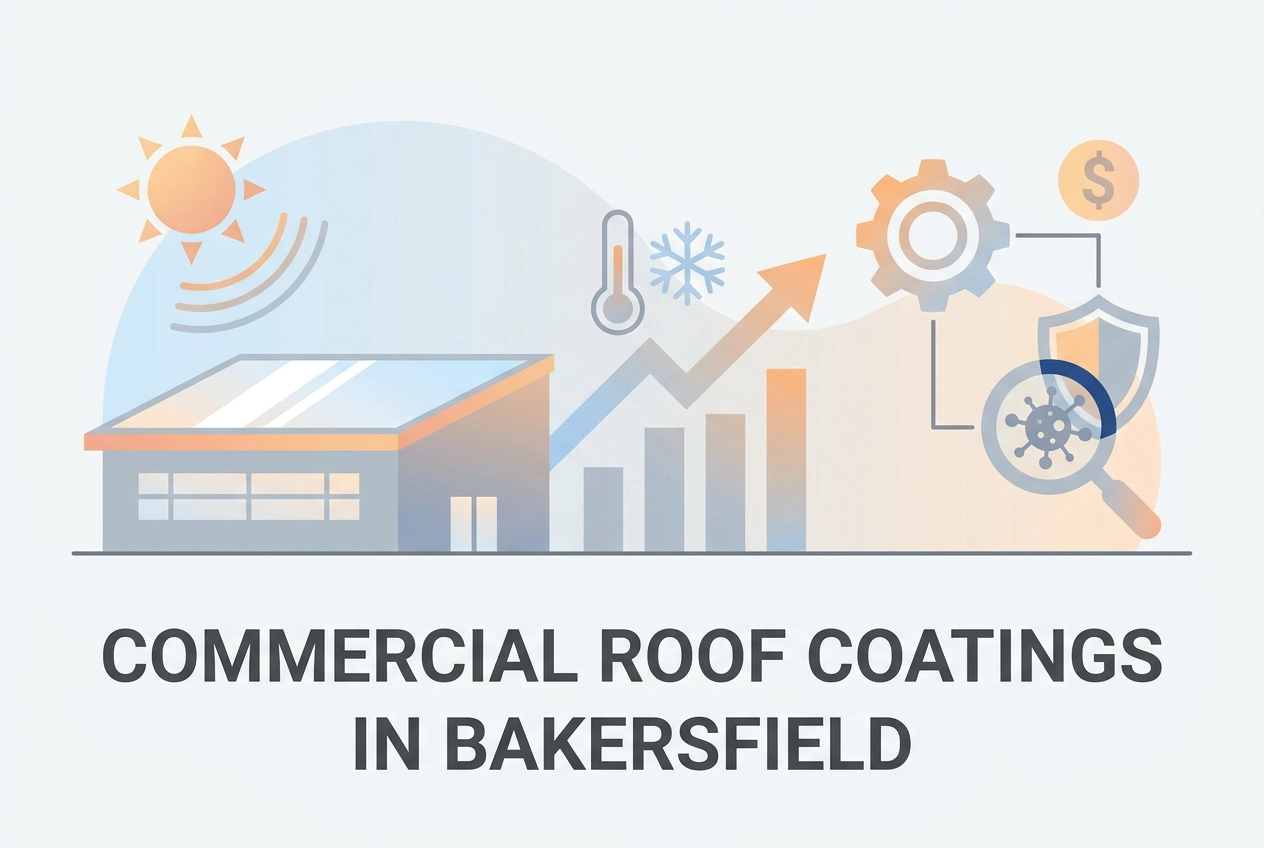
When summer temperatures in Bakersfield regularly reach 99–105°F, your commercial roof is not just a structural component; it is a financial liability or an asset, depending on how you manage it. For warehouse and retail property owners watching energy bills spike and aging flat roofs inch closer to full replacement, a professionally applied roof coating offers a compelling alternative worth serious consideration.
This is not a discussion about slapping a patch on a problem roof. Working with a qualified commercial roof coating contractor gives you access to a proven asset-management strategy that can meaningfully extend the life of an existing roof, cut peak cooling loads, and keep your building aligned with California's increasingly strict Title 24 energy code requirements.
In the analysis ahead, you will learn exactly how roof coatings perform under Bakersfield's extreme climate conditions, what California's cool-roof mandates actually require of nonresidential property owners, and how to calculate whether a coating or a full replacement delivers the stronger return on investment for your specific situation.
Why Bakersfield's Climate Makes Roof Coatings a Business Decision, Not a Band-Aid
Bakersfield sits in one of California's most demanding climate zones, with summer air temperatures regularly pushing toward 105°F. For commercial properties with large flat roofs, that ambient heat is only part of the problem. Dark roofing membranes absorb solar radiation directly, driving surface temperatures well beyond ambient air temperature at peak hours. That heat doesn't stay on the roof surface; it transfers into the building envelope, raises attic temperatures, and forces HVAC systems to run harder precisely when utility rates are highest.
The financial damage compounds quietly. Extreme thermal cycling, UV exposure, and sustained high surface temperatures accelerate membrane degradation, shortening the serviceable life of an asset that costs significantly more to replace than to protect. Most property owners respond by deferring action, which means paying higher cooling bills every summer while the membrane deteriorates toward a replacement that could have been delayed by a decade or more.
A roof coating reframes that equation entirely. Rather than watching a roof age toward replacement while operating expenses climb, owners who invest in a professionally applied reflective coating protect the membrane and reduce cooling loads at the same time. For warehouses and retail properties with large roof footprints, even a modest reduction in peak cooling demand produces measurable annual utility savings. Understanding what roof coating costs in Bakersfield typically reveals a payback period that surprises property owners accustomed to thinking about roofing only as an expense.
That is the core argument: in Bakersfield's climate zone, a roof coating is not a repair patch. It is a proactive capital-management tool with a documented return on investment, and the local operating environment makes the case unusually compelling.
What a Commercial Roof Coating Actually Does to Your Roof
A roof coating is not paint and it is not a patch. It is a fluid-applied membrane, typically formulated from silicone, acrylic, or polyurethane, that is rolled or sprayed directly onto the existing substrate and cures into a seamless, fully bonded waterproof layer. The underlying roof stays in place; the coating becomes its new protective surface.
Two physical properties determine performance. Solar reflectance (SR) measures the coating's ability to reflect incoming solar energy back into the atmosphere, rated 0 to 1 where 1.0 is perfect reflection. Thermal emittance (TE) measures how efficiently the coating releases absorbed heat rather than transferring it into the building, also rated 0 to 1. Both values are independently verified by the Cool Roof Rating Council.
When SR and TE work together, the result is a dramatically cooler roof surface. Lower surface temperatures reduce thermal stress cycling, the primary mechanism behind cracks, seam separations, and premature aging. Less heat transfer into the building envelope means reduced cooling demand during Bakersfield's peak-rate summer hours.
Coatings also restore waterproofing. The fluid application bridges minor surface cracks, re-seals lap seams, and encapsulates failing flashings, directly extending the watertight service life of the roof beneath.
The combined outcome is a roof that functions closer to a new system with no tear-off, no landfill disposal, and none of the operational disruption that comes with full commercial roof replacement. For an occupied warehouse or retail property, that distinction carries real value beyond material cost savings.
California Title 24 Cool-Roof Requirements: What Bakersfield Property Owners Must Know
Those same SR and TE metrics, introduced above, are also the legal currency of California's Title 24 Energy Code, and they matter only if the coating you install is legally compliant. For Bakersfield commercial property owners, that means understanding California's Title 24 Energy Code before work begins.
What Title 24 Requires
Title 24 mandates cool-roof performance standards for nonresidential buildings on new construction, additions, and reroofing projects. Permit applications must comply as of January 1, 2026, making this an active enforcement concern for any Bakersfield property owner planning roofing work.
CRRC Certification Is Non-Negotiable
The Cool Roof Rating Council (CRRC) is the sole authority for certifying SR and TE values under Title 24. Any coating on a permitted reroofing project must carry a CRRC label with independently verified ratings. Energy Star certification alone does not satisfy this requirement.
SRI Flexibility
Rather than requiring fixed SR and TE thresholds, Title 24 permits compliance through the Solar Reflectance Index (SRI), calculated using the California Energy Commission's official tool. This allows property owners and contractors to select products that reach the standard through different performance combinations.
The "Reroofing Alteration" Trigger
Not every coating job triggers full Title 24 compliance. The threshold is reached when more than 50% or 2,000 square feet of roof surface, whichever is less, is replaced, recovered, or recoated under a permit. Misclassifying scope is where permit surprises happen; a knowledgeable contractor confirms compliance obligations before work starts.
The Stakes of Non-Compliance
On a permitted project, installing a non-CRRC-verified coating can delay your certificate of occupancy, create liability during property sales or insurance claims, and require expensive remediation. Product selection is a legal and financial decision, not only a technical one. Reaching out to a qualified contractor early costs nothing and can prevent costly corrections later.
The ROI Case: Roof Life Extension vs. Early Replacement
The financial logic builds on what the asset's condition already tells you: a structurally sound roof still has value a coating can preserve. Compliance requirements establish what your coating must achieve. The financial case explains why acting now consistently outperforms waiting.
A professionally applied cool-roof coating on a structurally sound but aging flat roof can meaningfully extend the serviceable life of a structurally sound membrane, directly deferring the capital outlay of a full commercial roof replacement, which runs significantly higher per square foot than a coating application. That cost gap is the foundation of the ROI argument.
Energy savings compound that return. The California Energy Commission notes that cool roofs can decrease air conditioning demand and lower energy costs. All three benefits apply directly to Bakersfield's operating environment, where summer heat runs extreme and peak utility rates create the most expensive hours of the operating year. Research from Lawrence Berkeley National Laboratory suggests cool roofs can reduce peak AC demand by as much as 50% under optimal conditions; even a meaningful reduction in peak AC demand represents a measurable line item against annual operating costs for warehouse and large retail properties, not a rounding error.
Warranty coverage closes the financial case. Many leading commercial coating manufacturers extend substantial warranty coverage, contingent on certified installation, reflecting documented confidence in system longevity. That performance guarantee is something a deferred maintenance strategy simply cannot replicate.
When a Coating Makes Sense and When Replacement Is the Right Call
That ROI case only holds if your roof is actually a coating candidate. Not every aging flat roof qualifies, and misreading that distinction is where capital gets wasted.
A coating is appropriate when the existing membrane is structurally intact, drainage is functioning adequately, and the insulation beneath the membrane is dry. A professional moisture survey or core sample can confirm all three before coating work begins. Skipping that step is not a cost saving; it is a setup for premature failure.
Red flags that push a roof toward replacement instead:
Widespread wet insulation detected by infrared scan
Structural deck deterioration or soft spots
Extensive membrane delamination
Active ponding water without viable slope correction
Coating over these conditions delays costs without resolving the underlying problem. As a widely cited industry rule of thumb, when a moisture survey reveals substantial wet insulation across a significant portion of the roof, the economics shift decisively toward replacement. At that point, coating expenditure is largely wasted on a system requiring full tear-off within a few years regardless.
For roofs between clearly coatable and clearly replacement-bound, a phased approach often produces the best outcome. Repair isolated problem areas first, restore proper drainage, then apply the coating to the stabilized substrate. That sequenced scope is exactly what a qualified commercial roofing company should assess and recommend.
Property owners should be cautious at both ends of the contractor spectrum. Reviewing signs you need a roof replacement instead of a repair before any contractor conversation gives you a baseline for evaluating whether a recommendation reflects honest assessment or invoice size. A contractor who quotes a coating without a thorough inspection, or pushes full replacement on a roof with membrane life remaining, is not serving the asset.
How to Choose the Right Commercial Roof Coating Contractor in Bakersfield
Once you've confirmed your roof is a coating candidate, the next decision is who applies it, and that choice carries more financial and legal weight than most property owners expect.
Beyond knowing their compliance obligations, the right contractor must also be manufacturer-certified to protect your warranty. Any contractor you consider should be able to immediately cite the SR and TE values of their proposed product and confirm whether your project triggers a Title 24 permit requirement.
Manufacturer certification protects your warranty. Leading coating manufacturers require contractors to complete product-specific training before issuing full system warranties. An installer who applies the right product without that certification voids warranty protection entirely, leaving you with no recourse on a long-term asset.
Demand a written scope with surface preparation details. Preparation is where legitimate commercial roofers separate from low-bid competitors. A coating applied over contaminated, wet, or structurally compromised substrate will fail early regardless of product quality. Any scope that skips preparation specifics is a warning sign.
Local experience in Kern County matters. Contractors who routinely work with Bakersfield's heat levels, dust exposure, and prevalent substrates, including TPO, modified bitumen, and built-up roofs, will specify systems proven to perform under those conditions. General roofing experience is not a substitute for regional familiarity.
Verify references from comparable properties. Ask for documented work on warehouses, retail centers, or multi-unit properties in the Bakersfield area. A verifiable local track record outweighs certifications alone when you're evaluating a commercial roofing company. Ready to get started? A professional maintenance assessment is a practical first step before committing to any coating contractor.
Utility Rebates and Incentives: Reducing Your Out-of-Pocket Costs Further
Selecting the right contractor is only part of the cost equation. The gross installation price of a commercial roof coating is rarely the final number that matters.
California property owners installing CRRC-compliant cool-roof systems may qualify for utility rebate programs through PG&E and other regional providers. Eligibility typically requires documentation of pre- and post-installation SR and TE values, so retaining your contractor's product data sheets and any third-party measurement results is essential from the start.
The California Energy Commission's online resources include energy efficiency guidance, and programs such as Energy Upgrade California may offer support for commercial building upgrades that achieve measurable energy efficiency improvements. Check directly with your utility provider and the Commission's resources to confirm what is currently available in your service territory.
A pre-installation energy audit strengthens the rebate case considerably. Establishing a baseline cooling cost before the coating is applied, then documenting post-installation performance, gives you the comparison data many rebate programs require and provides independent validation of your ROI projections.
One critical procedural point: check current program terms directly with your utility provider, as eligibility and pre-approval requirements vary and change over time. Some programs do not allow retroactive claims, so verify before work begins. An incentive that appears available after project completion may not be claimable at that point.
When you account for all three variables together, deferred replacement capital, reduced annual cooling costs, and available rebates, the effective out-of-pocket cost of a commercial roof coating is often substantially lower than the gross installation price. A complete financial analysis should treat all three as real offsets, not optional line items.
To understand how our story and service approach translate into a full asset-management recommendation for your property, the next section brings the entire business case together.
The Bottom Line for Bakersfield Commercial Property Owners
Those three outcomes, life extension, cost reduction, and compliance, are well-established above; what the Bottom Line adds is a clear action sequence.
With rebates, deferred replacement costs, and reduced cooling expenses all working together, the financial case is as strong as it gets for a roofing investment.
The action sequence is straightforward. Commission a professional roof inspection and moisture survey. Confirm the substrate is coating-eligible. Select a CRRC-rated system through a certified contractor. Verify permit requirements before work begins. That four-step process protects the investment and keeps the project compliant from the start.
Deferral carries a real cost that property owners often underestimate. Each Bakersfield summer without a reflective coating accelerates membrane degradation under peak radiant heat and forfeits cooling-cost savings that compound year over year. Waiting does not preserve options; it erodes them.
K-9 Custom Roofing Inc. provides full-service coating assessments, CRRC-compliant product specification, and certified installation for commercial property owners across Bakersfield. Reach out to the K-9 team for a no-obligation roof evaluation before next summer's heat arrives.
Conclusion
Bakersfield's extreme heat makes commercial roof coatings one of the highest-return investments available to property owners today. The Bakersfield summer heat cycle waits for no one, acting before peak season means the first season's savings begin immediately. Schedule a professional roof assessment with K-9 Custom Roofing Inc. today and get an honest evaluation from a team that prioritizes your roof's long-term performance over unnecessary upsells.
Frequently asked questions
- How long can a professional roof coating extend the life of my commercial roof in Bakersfield?
- A professionally applied roof coating on a structurally sound membrane can meaningfully extend its serviceable life, often deferring the need for full replacement by several years. The exact extension depends on your roof's current condition, local climate stress, and maintenance practices. A professional inspection and moisture survey can provide a more precise estimate for your specific property. This life extension, combined with energy savings and deferred replacement costs, creates the compelling ROI case that makes coatings attractive in Bakersfield's extreme heat environment.
- What is the difference between a roof coating and a roof repair or patch?
- A roof coating is a fluid-applied membrane—typically formulated from silicone, acrylic, or polyurethane—that is rolled or sprayed onto the existing substrate and cures into a seamless, fully bonded waterproof layer. Unlike temporary patches, coatings restore the entire protective surface, bridge minor cracks, re-seal lap seams, and encapsulate failing flashings. The underlying roof remains in place, and the coating becomes its new protective surface. This provides comprehensive protection without the operational disruption, landfill costs, or tear-off requirements of full replacement.
- Do I need to comply with California Title 24 for a roof coating project in Bakersfield?
- Title 24 compliance requirements depend on your project scope. If you're replacing, recovering, or recoating more than 50% or 2,000 square feet (whichever is less) of roof surface under a permit, you must use a CRRC-certified coating with independently verified Solar Reflectance (SR) and Thermal Emittance (TE) values. Energy Star certification alone does not satisfy Title 24. As of January 1, 2026, permit applications must comply. Non-compliance can delay your certificate of occupancy and create liability during property sales or insurance claims, so verify requirements with a qualified contractor before work begins.
- How much can a cool roof coating reduce my summer cooling costs in Bakersfield?
- Research from Lawrence Berkeley National Laboratory suggests cool roofs can reduce peak AC demand by as much as 50% under optimal conditions. For warehouses and large retail properties in Bakersfield—where summer temperatures regularly reach 99–105°F and peak utility rates create the most expensive operating hours—even a meaningful reduction in peak AC demand represents a measurable annual savings. The California Energy Commission confirms that cool roofs can decrease air conditioning demand and lower energy costs. Your exact savings depend on your building size, roof footprint, and current cooling efficiency, but the potential savings are significant enough to offset installation costs over time.
- When should I choose roof replacement instead of a coating?
- A roof coating is appropriate only when the existing membrane is structurally intact, drainage is functioning adequately, and the insulation beneath the membrane is dry. Red flags indicating replacement is needed instead include: widespread wet insulation detected by infrared scan, structural deck deterioration or soft spots, extensive membrane delamination, and active ponding water without viable slope correction. A professional moisture survey or core sample should confirm your roof's condition before coating work begins. When substantial wet insulation is detected across significant roof portions, the economics shift decisively toward replacement, as coating expenditure would largely be wasted on a system requiring tear-off within a few years.