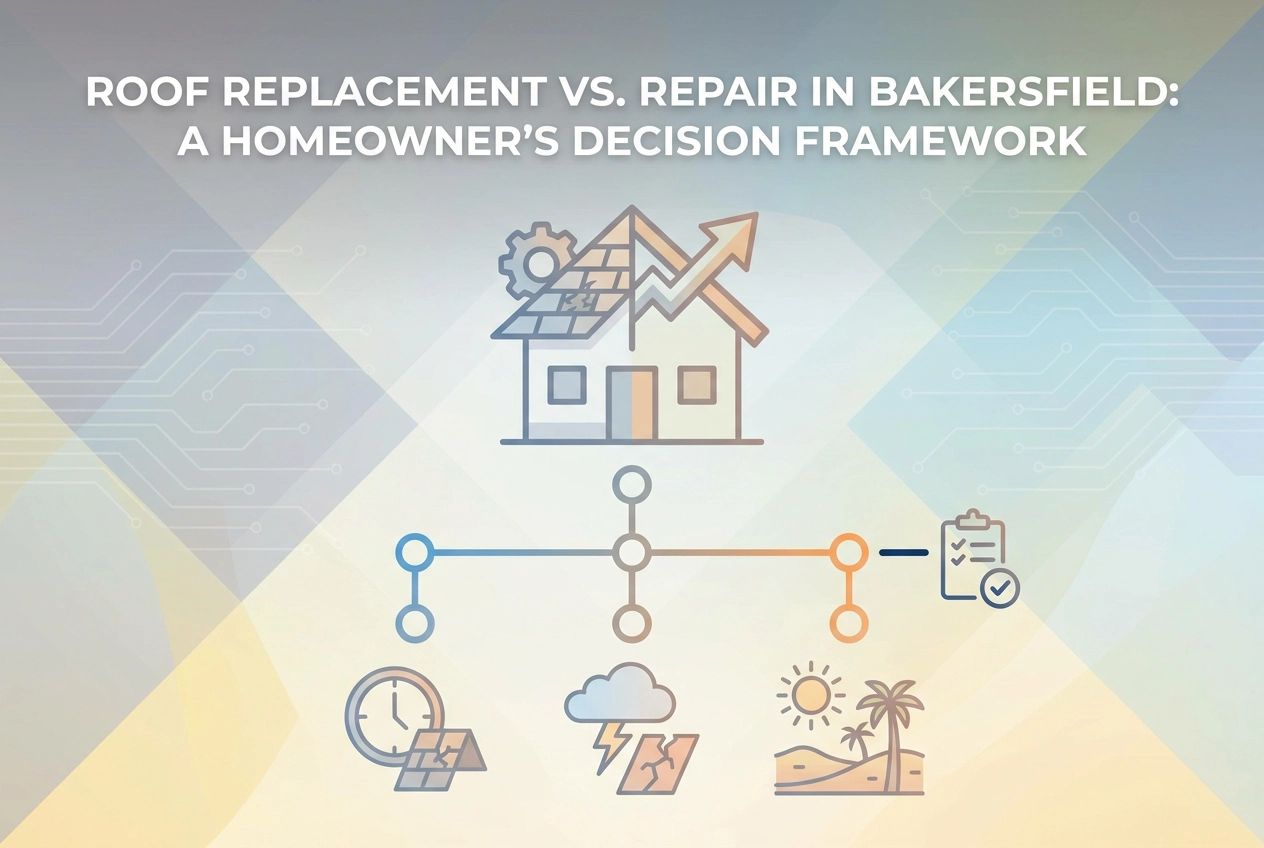
Roof Replacement vs. Repair in Bakersfield: A Homeowner's Decision Framework
Roof repair or replacement? Learn the 5-step decision framework for Bakersfield homes to avoid overspending and make the right choice.
Most homeowners discover a roofing problem and immediately ask the wrong question. They call a contractor and ask, "How bad is it?" when the question that actually protects their wallet is: "Does my roof's age, damage pattern, and remaining lifespan make repair a smart long-term fix, or just a bridge to an inevitable replacement?"
That distinction is worth thousands of dollars.
This guide gives you a concrete, step-by-step decision framework built around Bakersfield's specific climate conditions, local cost realities, and the material lifespans that actually apply to roofs in the Central Valley. You will learn how to assess your roof's age and condition, identify what your damage pattern is really telling you, apply a simple cost test before accepting any contractor quote, and understand what your insurance policy will and won't cover.
By the time you finish reading, you will know exactly which outcome to push for before you contact roof replacement companies or repair contractors. No more walking into that conversation blind. No more overspending on a repair that buys you two years, or rushing into a full replacement you did not yet need.
Why Most Homeowners Are Asking the Wrong Question
When a roof starts leaking or showing visible damage, most homeowners ask their contractor one question: "How bad is it?" That question feels logical, but it frames the entire conversation around the wrong variable.
Damage severity only tells you what happened. It says nothing about whether your roof has enough remaining life to make a repair worthwhile, or whether you're about to spend on a repair now and face a full replacement bill a few years later to finish the job you should have done today.
This gap creates a real risk. A contractor who jumps straight to a repair quote without addressing age and material condition may simply be optimizing for the easier, lower-friction sale. That's not always the case, but you shouldn't have to guess. If you have questions about roof repairs and what a proper assessment should include, that's a reasonable place to start.
This post gives you a five-step decision sequence to work through before any contractor conversation.
Step 1: Establish Your Roof's Age and Material Lifespan
The first number you need isn't a damage estimate. It's an installation date.
Material lifespans vary widely, ask your contractor for the manufacturer's rated lifespan for your specific product and grade. Local conditions can materially compress those ranges, and Bakersfield's combination of intense heat and UV exposure means lower-grade products age faster than manufacturer estimates suggest. You can review how roofing materials compare on cost and lifespan to see how grades stack up before any contractor visit.
Two age thresholds drive most decisions. Roofs under 15 years old with isolated damage are generally strong repair candidates. Roofs over 20 years old should be evaluated for replacement regardless of how minor the visible damage looks.
That second rule exists because age outweighs appearance. A 22-year-old shingle roof with one leaking valley is like a worn-out tire with a nail in it. Patching the nail doesn't change what the tire has left.
To find your installation date, check your original home inspection report, search building permit records through Kern County Public Works, or ask a contractor to read the datestamp embedded in a shingle sample.
Before any contractor arrives, document your material type and grade. Premium-grade asphalt shingles hold up significantly better under Bakersfield's UV and heat load than standard three-tab products installed at the same time.
Step 2: Identify the Damage Pattern, Not Just the Damage
Once you know your roof's age, the next question shifts to where the damage is and how many places it shows up.
Isolated damage and systemic damage are not the same problem. A single cracked tile, missing shingle section, or failed flashing joint is a localized failure with a specific cause. Systemic damage such as granule loss across multiple slopes, widespread shingle curling, or soft decking in the attic means the roof is aging out as a whole.
In Bakersfield, three damage patterns are worth knowing before any inspection:
UV-driven granule loss starts on south-facing slopes first, which absorb the most direct sun.
Flashing joints are vulnerable to debris accumulation; after dust events, inspect visible joints for compromised seals.
Heat cycling causes shingle curling across entire sections. If you see curling on one shingle, check the full slope before drawing conclusions.
Repair-friendly signals: storm punctures on a younger roof, a single failed flashing at one penetration, or a lifted section with intact underlayment beneath it.
Replacement signals: granule deposits in gutters at more than one downspout, curling or cupping across multiple slopes, interior water stains in more than one room, or soft decking in the attic. Reviewing the signs you need a roof replacement instead of a repair can help you match what you are seeing to each category.
The pattern test is simple: when damage appears in multiple locations or from more than one apparent cause, treat it as a signal of systemic aging rather than an isolated event. That distinction changes every number in your cost calculation.
Step 3: Run the 50% Cost Test Before Accepting Any Quote
Once you know your damage pattern, the next question is financial. The 50% cost test gives you a concrete number to work with before you accept any quote.
The rule is straightforward: if the cost of repairing your roof exceeds 50% of the cost of replacing it entirely, replacement is typically the smarter financial decision. You would be spending most of the money for none of the long-term value.
Repair costs in Bakersfield vary widely based on scope, minor patching is far less expensive than valley or section work, while full replacement costs depend on home size, pitch, material grade, and tear-off requirements. Get written estimates for both repair and replacement before applying the 50% test.
To run the test honestly, get a written repair estimate with a full scope first, then ask your contractor for a ballpark replacement figure on the same structure. You need both numbers.
Watch for incomplete repair scopes. A flashing repair that ignores adjacent shingle condition, or a valley repair that leaves deteriorated underlayment in place, will likely generate another service call in the near term. That follow-up cost belongs in your repair total. Understanding what roof maintenance costs in Bakersfield helps you anticipate those recurring expenses before they accumulate.
Treat the 50% threshold as a floor, not a ceiling. A repair priced at 40% of replacement may still be a poor investment on a 23-year-old roof with only two or three functional years remaining regardless of the fix.
Step 4: Understand What Your Insurance Policy Will and Won't Cover
Once you know what repair or replacement will cost, your insurance policy determines how much of that cost you actually bear. Getting this wrong can make a sound repair decision unravel fast.
ACV vs. RCV: the distinction that changes your math
California homeowners' policies fall into two categories. Replacement cost value (RCV) policies pay the full cost to replace your roof minus your deductible. Actual cash value (ACV) policies subtract depreciation based on age and condition. On an aging asphalt shingle roof under an ACV policy, depreciation can substantially reduce your payout, sometimes shifting the smarter financial move toward full replacement even for moderate damage.
What insurance covers and what it doesn't
Review your policy's named perils and exclusions carefully, coverage for sudden storm damage typically differs from coverage for gradual wear, and the distinction matters significantly for heat-driven roof aging. In Bakersfield, where heat-driven aging is the primary failure mode for most roofs, this distinction matters significantly. If your roof failed due to slow thermal degradation rather than a discrete storm event, you may be filing a claim against a gap in your coverage.
File strategically, not reflexively
A repair-only claim can trigger a policy review or premium adjustment even when approved. Before filing, ask your insurer directly whether a repair settlement now would limit or complicate a subsequent replacement claim.
Before signing any repair contract, pull your declarations page, locate the roof-specific loss settlement language, and confirm your policy type. If you are ready to get started with a professional assessment, knowing your coverage structure before that conversation will sharpen every decision that follows.
Step 5: Apply the Decision Rules to Your Specific Situation
With your age, damage pattern, insurance picture, and cost numbers in hand, the decision becomes straightforward for most roofs.
Repair is the right call when your roof is under 15 years old, the damage traces to a single identifiable cause, the repair cost sits well under 40% of full replacement, and the rest of the roof shows no systemic aging signals.
Replacement is the right call when your roof is over 20 years old regardless of how limited the visible damage looks, the repair cost exceeds 50% of replacement, aging patterns appear across multiple areas, or your insurance policy would meaningfully offset replacement costs anyway.
The gray zone covers roofs between 15 and 20 years old with moderate damage. Here, the right answer depends on material grade, maintenance history, and whether the damage is genuinely isolated. A detailed inspection from a qualified residential roof replacement contractor is non-negotiable before committing either way. Do not guess in this range.
Bakersfield adds one more variable. Heat cycling, UV intensity, and dust exposure degrade roofing materials below the surface, so a roof at the upper end of its lifespan often looks better than it actually is. For any roof approaching the upper end of its expected lifespan, attic inspection to assess decking condition and underlayment integrity is essential, not optional.
Treat these rules as your agenda for the contractor conversation. Ask any repair or replacement contractor to walk through their recommendation against each factor explicitly, and expect clear answers.
The Bakersfield Climate Factor: Why National Averages Don't Apply Here
Those decision rules assume national material lifespans. In Bakersfield, the underlying numbers are compressed before you even apply them.
Bakersfield's summers bring sustained extreme heat. Under conditions like that, asphalt shingles soften, blister, and shed their granule coating significantly faster than the same product installed in a moderate climate. Manufacturer warranties are tested under average conditions; Bakersfield is not average.
Thermal cycling compounds the problem. Every day, roofing materials expand in afternoon heat and contract overnight. That repeated movement stresses sealant strips, pulls at nail attachment points, and fatigues flashing joints at a pace that national lifespan estimates simply don't account for.
UV intensity at Bakersfield's latitude accelerates degradation of every polymer-based roofing component: sealants, underlayments, and modified bitumen membranes on flat roofs. The benchmarks most national guides cite reflect moderate climates with materially lower UV load.
Seasonal dust storms add a fourth stressor. Abrasive particulate from recurring Kern County wind events scours granule surfaces and packs into valley drainage channels, creating standing water conditions that undermine even recently completed repairs.
The practical adjustment: subtract several years from any national material lifespan figure when evaluating a Bakersfield roof, Bakersfield's conditions accelerate degradation measurably. For standard three-tab asphalt shingles installed before 2015, treat the 15-year repair threshold as compressed under Bakersfield conditions, consult a local contractor for a current condition assessment rather than relying on age alone. The framework is sound; the inputs just need to reflect where you actually live.
How to Use This Framework When Talking to a Roofing Contractor
Knowing the framework is only half the work. Putting it into practice in a real contractor conversation is where homeowners either protect themselves or lose ground.
Before the contractor arrives, pull three things: your roof's installation date, your insurance declarations page, and any previous repair invoices. These documents give you a complete timeline and signal immediately that you are an informed buyer, not a passive one.
Two questions to ask every contractor, whether you are looking at roof repair in Bakersfield or considering a full replacement:
"What is the estimated remaining lifespan of my roof after this repair?"
"At what point would you recommend replacement instead?"
A contractor who cannot answer both clearly is telling you something useful about their process.
Watch for these red flags:
A repair-only quote that ignores the condition of adjacent shingles or flashing
A replacement recommendation on a roof under 15 years old with isolated damage
Any quote delivered without a written scope of work
A thorough inspection for a Bakersfield home should cover the attic (decking integrity and insulation condition), flashing at every penetration and valley, granule loss measured across multiple slopes, and underlayment condition where accessible. Surface-only walkovers miss the failure points that matter most here.
K-9 Custom Roofing works with Bakersfield homeowners on both roof repair and full replacement. Their consultations are structured around this framework, not around steering you toward the higher-cost outcome. Get a free quote today.
Your Next Step: Enter the Contractor Conversation Ready
Now that you have the framework and the right questions in hand, the path forward is straightforward.
Working through the five steps in sequence, age, damage pattern, cost test, insurance, and decision rules, leaves you with a clear outcome rather than a guess.
The practical next step: contact K-9 Custom Roofing Inc. for a roof inspection structured around this framework. Whether the outcome is repair or full replacement, you will get a recommendation tied to age, damage pattern, cost comparison, and material condition, not just what is visible from the ground.
Homeowners who work through these five steps before a contractor visit evaluate recommendations more clearly, avoid over-spending in either direction, and make a decision that holds for the long term.
Conclusion
The framework covers the four variables that matter: age, damage pattern, cost ratios, and insurance coverage. You now have it. The next move is to put it to work. Contact K-9 Custom Roofing Inc. for an inspection built around these exact criteria. Come prepared, ask the right questions, and leave with a recommendation you can trust. A well-informed decision today protects your home and your budget for years ahead.
Frequently asked questions
- What is the 50% cost test and how do I use it to decide between repair and replacement?
- The 50% cost test is a simple financial rule: if the cost of repairing your roof exceeds 50% of the cost of replacing it entirely, replacement is typically the smarter financial decision. To apply it, get written estimates for both repair and replacement costs from your contractor, then compare them. If the repair cost is more than 50% of the full replacement cost, you would be spending most of the money for none of the long-term value. Treat 50% as a floor, not a ceiling—even a repair at 40% of replacement cost may be poor value on an older roof with limited remaining lifespan.
- At what roof age should I start considering replacement instead of repair?
- Roofs under 15 years old with isolated damage are generally strong repair candidates. However, roofs over 20 years old should be evaluated for replacement regardless of how minor the visible damage looks, because age outweighs appearance. In Bakersfield specifically, the harsh climate conditions (extreme heat, UV intensity, and dust storms) compress material lifespans, so you should subtract several years from national lifespan estimates. For roofs between 15-20 years old, the decision depends on material grade, maintenance history, and whether damage is genuinely isolated—a detailed professional inspection is essential before committing to either repair or replacement.
- How does Bakersfield's climate affect my roof's lifespan compared to national averages?
- Bakersfield's climate significantly accelerates roof degradation through four main stressors: sustained extreme heat softens shingles and reduces granule coating durability; thermal cycling (daily expansion and contraction) stresses sealants and flashing joints; intense UV radiation degrades all polymer-based components faster than manufacturer estimates account for; and seasonal dust storms scour granule surfaces and clog drainage channels. Manufacturer warranties are tested under average conditions, but Bakersfield is not average. For standard three-tab asphalt shingles, subtract several years from national lifespan figures when evaluating your roof. This is why consulting a local contractor familiar with Bakersfield conditions is essential rather than relying on age alone.
- What questions should I ask my roofing contractor to ensure I'm making the right repair or replacement decision?
- Ask every contractor these two critical questions: (1) 'What is the estimated remaining lifespan of my roof after this repair?' and (2) 'At what point would you recommend replacement instead?' A contractor who cannot answer both clearly is telling you something important about their assessment process. Before the visit, pull your roof's installation date, insurance declarations page, and any previous repair invoices to signal you're an informed buyer. Also watch for red flags: repair quotes that ignore adjacent shingle or flashing condition, replacement recommendations on roofs under 15 years old with isolated damage, or quotes without a written scope of work.
- Will my homeowners insurance cover a roof repair or replacement, and how do ACV vs. RCV policies affect my decision?
- Your insurance policy structure significantly impacts your out-of-pocket costs. California homeowners fall into two categories: Replacement Cost Value (RCV) policies pay the full replacement cost minus your deductible, while Actual Cash Value (ACV) policies subtract depreciation based on age and condition. On aging asphalt shingle roofs under an ACV policy, depreciation can substantially reduce your payout, sometimes shifting the smarter financial move toward full replacement even for moderate damage. Additionally, coverage for gradual wear differs from sudden storm damage, and in Bakersfield where heat-driven aging is the primary failure mode, slow thermal degradation may not be covered. Before filing any claim, ask your insurer whether a repair settlement now would limit a subsequent replacement claim. Always review your policy's declarations page and roof-specific loss settlement language before committing to any contractor agreement.