Roof Waterproofing: What It Fixes and What It Hides
Roof waterproofing can buy years on a sound Bakersfield roof or hide failure on a spent one. Here is how to tell the difference before you spend money.
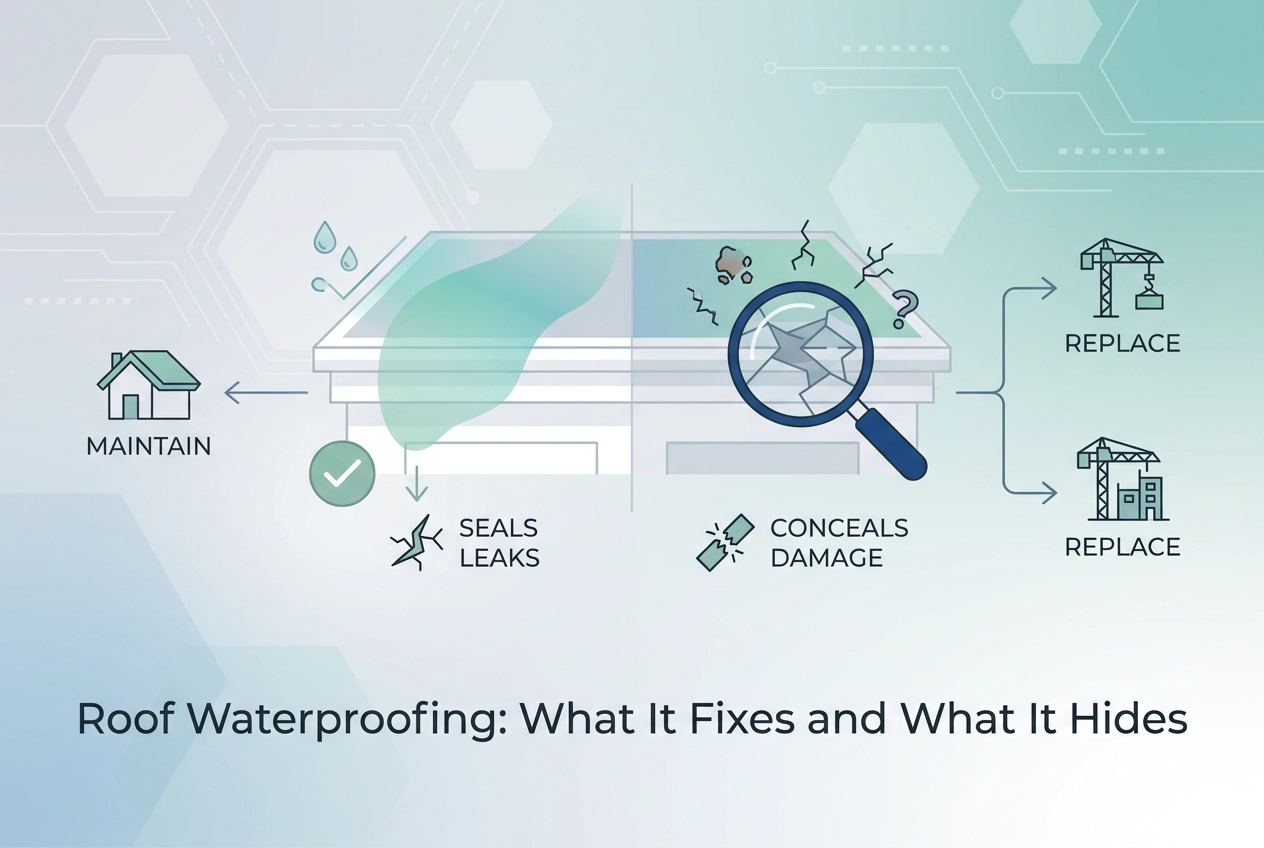
A roof leak rarely announces itself with a dramatic collapse. It usually begins as a faint ceiling stain, a lifted shingle, or a drip you hear only during the first hard rain. That is where roof waterproofing enters the conversation. Applied to a sound roof at the right time, waterproofing sealants, coatings, and membrane repairs can extend service life and stop small intrusions. Applied to a roof already past its structural limits, the same products can hide damage, delay the inevitable, and turn a known replacement cost into a surprise.
This tutorial is an honest triage framework for beginners, not a sales pitch. You will learn what roof waterproofing actually means and what it does not do; how sealants, coatings, and paint differ; when waterproofing applies to shingle roofs versus low-slope membrane roofs; and which signs suggest a coating will buy years versus merely delay replacement. We will also cover why Bakersfield heat, UV, and dust change the lifespan math, how commercial low-slope roofs require a different conversation, when to call for a roof assessment and what to ask, and the three questions that make the decision clearer.
What Roof Waterproofing Actually Means, and What It Does Not Do
Waterproofing products slow water's path into a roof. Three types matter.
Sealants are targeted flexible materials for joints, penetrations, flashing, and cracks. Coatings are field-applied films across a roof surface. Membranes are sheet or fluid systems used mostly on low-slope roofs. Most products sold to homeowners as waterproofing are water-management tools, not a true waterproof envelope.
Industry scope backs that caution. The NRCA Repair Manual for Asphalt Shingle Roof Systems, released in December 2022, documents 31 repair procedures and deliberately excludes temporary, emergency, unconventional, and regionally specific work, referring complex repairs to project-specific evaluation. That exclusion signals that some conditions need diagnosis, not a product.
Waterproofing does not restore structural strength, replace lost granule protection, fix a wet or deteriorated deck, or stop water entering elsewhere.
Two Bakersfield roofs, two very different answers. Before calling anyone, ask: Is the deck sound? Is the leak local or systemic? Is the surface intact? Commercial low-slope roofs follow the same logic with different products, including roof coatings that extend flat roof life and cut cooling costs.
Roof Waterproofing Sealant, Coating, or Paint: What Each One Can Fix
Sealants, Coatings, and Paint Are Not Interchangeable
A roof waterproofing sealant is a spot tool. Use it where the roof is fine except at one defined point: pipe boots, vent collars, chimney counter-flashing, valleys, or hairline cracks in a sound surface. It solves one problem, not a pattern of problems.
A waterproofing roof coating is a surface tool. It works on prepared, sound substrates, usually low-slope membranes or metal, and hot-climate formulations lean on reflectivity and UV resistance to slow surface degradation. Surface prep is part of the product, so the roof coating you buy is the coating plus the cleaning and priming beneath it. Industry guidance calls prep the most important step and requires dry, sound surfaces free of dirt, dust, and grease.
Roof waterproofing paint is largely a marketing phrase. Compare the technical data sheet instead: dry film thickness, elongation, tensile strength, substrate compatibility, and required preparation. Two products sold as waterproof paint can behave nothing alike.
Where Most Failures Begin
Coatings and sealants applied over dust, standing moisture, chalky oxidation, or loose granules fail from underneath. In a dusty valley climate, prep belongs as an explicit line item in any quote. Ask any contractor what the coating manufacturer requires for the surface, and get that requirement in writing before work begins. Industry guidance prohibits applying coatings to wet, unsecured, or deteriorated surfaces, any contractor who does so is working outside the product's intended scope. If a contractor promises otherwise, ask for the written warranty language.
Does Waterproofing Apply to Your Roof? Shingle Versus Low-Slope Membrane
Your roof's type decides whether waterproofing is even an option. Asphalt shingles have the narrowest window. The NRCA's 30-page homeowner guide, Asphalt Shingle Roof Systems: A Homeowner's Guide for Inspection, Maintenance and Repair (fall 2020), frames shingle work as inspection, maintenance, and repair, not resurfacing. On shingles, waterproofing means sealing specific failures at flashings, boots, and valleys, never coating the whole field.
Low-slope and flat roofs are the opposite case. Coatings and membrane systems have a legitimate, well-established role here, which is why commercial property owners often get a genuinely different answer than homeowners. On these roofs, signs your flat roof is a coating candidate start with the substrate and its condition.
Metal, tile, and modified bitumen each behave differently. The substrate dictates the product, not the reverse. A product that performs on a TPO membrane may be inappropriate on a clay tile roof.
Identify your roof type before pricing anything. Ask the contractor to state in writing the roof system, its approximate age, and the condition of the deck and insulation. Those three facts decide whether waterproofing is in play. K-9 Custom Roofing works with both homeowners and commercial properties, including retail, warehouse, and multi-unit buildings, so the assessment matches the recommendation to the actual roof system rather than to a single product line.
Signs a Waterproofing Coating Will Buy You Years
Four conditions separate a roof worth waterproofing from one that is not.
The deck is sound. Check the attic and the roof: no soft or spongy spots, no sagging, no daylight through the sheathing. No sealant or coating substitutes for structure, so this check comes first.
The problem is isolated and traceable. A dried-out pipe boot, one cracked sealant joint, a small flashing gap, or one valley weeping in heavy rain are isolated failures on a healthy roof, the cases where a waterproofing roof sealant performs as advertised.
The roof is in the early to middle of its service life. A maintenance and sealing program in those middle years can realistically extend the interval before replacement on a well-installed asphalt shingle roof, provided the surface below is intact.
The surface profile is intact. Granules cover the field, tabs lie flat, and there is no widespread curling or crumbling. Intrusion is recent, not a pattern recurring for several seasons.
Check | Waterproof now | Replace now |
|---|---|---|
Structure | Solid deck, no sagging | Soft or spongy decking |
Surface | Granules intact, flat tabs | Bald, curled, crumbling shingles |
Leaks | One recent, traceable leak | Repeat or multiple leaks |
Age | Early to middle of service life | At or past rated life |
Mostly middle-column answers justify waterproofing. Any right-column match calls for an assessment first, and if replacement is the honest answer, choosing the right roof replacement contractor matters more than product choice.
Signs Waterproofing Is Only Delaying Replacement
Now the harder case: roofs that look like waterproofing candidates but aren't. Here, a coating does not extend service life. It hides the clock.
Soft, spongy, or rotted decking. A coating applied over active rot is not maintenance. It is concealment, hiding damage from the next inspection while it keeps growing.
Widespread granule loss, curling, or crumbling shingles. Once the field is bald or the tabs are brittle, the shingle itself is spent. There is no surface left for a coating to bond to or protect.
Repeated leaks in the same location after repairs. One repair that holds is normal. The same area leaking again within a season or two means the failure is systemic, not local, and the next product applied will fail the same way. Recurring leaks are one of the clearest signs you need a roof repair, not another patch.
Multiple leak locations, or water showing up far from where it enters. Water travels along sheathing and framing, so ceiling stains in three rooms often trace back to one failing section, or to a bigger problem than drips suggest.
Interior warning signs. Attic mold, persistently high attic humidity, sagging sheathing, or a roof that visibly flexes underfoot. Any of these moves the answer from waterproofing to assessment and, in most cases, replacement.
The NRCA Repair Manual for Asphalt Shingle Roof Systems supports that line. It sets aside temporary, emergency, and complex repairs in favor of project-specific evaluation. A roof that needs design judgment rather than a procedure is not a coating candidate.
Then there is the money argument. Waterproofing money spent on a failing roof does not remove the eventual replacement cost. It adds to it, and it usually delays the discovery of interior damage that costs more than either option.
Why Bakersfield Heat, UV, and Dust Change the Lifespan Math
Bakersfield's climate, extended summers, intense UV, and low annual rainfall, means the conditions most product labels were not written for. A sealant given a generic lifespan estimate in product literature may deliver less in a high-heat, high-UV environment, ask the contractor to show the manufacturer's hot-climate technical data sheet rather than the label. For a fuller picture of how remaining service life factors into repair versus replacement, see Roof Replacement vs. Repair in Bakersfield: A Homeowner's Decision Framework.
Dust is the quiet failure point. Coatings and sealants bond to what is on the surface, so a clean, dry, primed substrate matters more here than in wetter, cleaner regions. It is also the step bargain-priced applications skip most often.
When rain does arrive, it tends to come in concentrated events, meaning a single neglected intrusion can cause a full season's worth of damage in a single storm, which makes pre-wet-season preparation practical rather than a sales tactic.
Flexible, high-elongation products tolerate thermal movement better than brittle ones. Because Bakersfield stresses these materials faster than mild climates do, schedule joint inspections on an interval your contractor recommends for your specific roof system, and put it on the calendar instead of waiting for a ceiling stain. The same climate pressures shape commercial low-slope decisions differently.
Commercial and Low-Slope Roofs: A Different Waterproofing Conversation
The same local conditions that shorten sealant life on a shingle roof also shift how commercial owners think about coatings.
Commercial and multi-unit buildings with low-slope roofs are where coatings serve as a legitimate, often cost-effective life-extension tool rather than a stopgap. This is the clearest case where waterproofing genuinely competes with replacement on price and performance.
Reflective coatings can reduce surface heat absorption on flat roofs, which has real value in a hot valley climate. But the benefit depends entirely on the membrane beneath being dry and sound. Reflectivity does not fix ponding, seam failure, or saturated insulation.
Blistering, standing water, open seams, and wet insulation cannot be coated away. Before approving any coating project, property managers should request membrane condition documentation, including moisture survey results where saturation is suspected. That documentation comes from a proper roof inspection services assessment, not a visual walkover.
For commercial properties, the most effective approach treats coating as a recurring line item in a capital plan rather than a reactive spend, your contractor should be able to sketch a maintenance timeline, not just quote today's work.
When to Call for a Roof Assessment, and What to Ask For
Commercial or residential, the answer arrives the same way: with an assessment, not a guess. Ask for a documented assessment rather than a phone quote. Those three questions, structural soundness, local versus systemic problem, realistic remaining service life, should appear in the written assessment you receive.
A contractor who answers all three in writing is giving you a framework, not a pitch.
Ask for the scope in writing, including surface preparation steps. A written scope showing surface preparation steps and materials used is worth having even without an active insurance claim, it shows which contractors plan the work properly and protects you if a dispute arises later. It also shows which contractors plan prep and which skip it, a real distinction when choosing roofers in Bakersfield.
Ask what happens if the waterproofing fails: warranty terms, who re-inspects, what voids coverage, and what the manufacturer requires for prep. A verbal promise is not a warranty.
K-9 Custom Roofing Inc. provides assessment, repair, leak prevention, maintenance, and full replacement in Bakersfield, so our recommendation is not tied to selling a coating. If waterproofing is right for your roof, we say so. If it is not, we say that too and quote your replacement honestly.
The Honest Triage in Three Questions
As laid out above, two or three yes answers to the structure, problem scope, and surface questions usually justify waterproofing; any no points toward assessment first.
The same roof waterproofing sealant or coating that extends a healthy roof's life conceals a failing roof's decline. The product is identical. Timing and roof condition decide which outcome you get.
So take one step before buying anything: schedule an inspection and get the scope, roof type, and remaining service life in writing. That habit prevents the most expensive mistake in this category, spending coating money on a roof that already needed replacing.
Conclusion
Roof waterproofing is a maintenance tool, not a cure. It can extend a sound, intact roof, especially when prep and warranty terms are clear. It cannot fix structural problems, widespread failure, or a roof already near replacement. In Bakersfield, heat, UV, and dust make timing and condition even more important.
The triage questions above give you the framework; an on-site inspection gives you the answer.
If waterproofing fits your roof, act with confidence. If it does not, replace honestly. Schedule your roof assessment with K-9 Custom Roofing Inc. today and protect your roof with facts, not guesswork.
Frequently asked questions
- Can roof waterproofing fix a leaking roof?
- Not always. Waterproofing products such as sealants, coatings, and membranes slow water's path into a roof, but they do not restore structural strength or fix a wet or deteriorated deck. They work best on a sound roof with an isolated, traceable leak, such as a dried-out pipe boot or a cracked sealant joint. If the leaks are repeated, widespread, or linked to soft decking, an assessment and likely a replacement is the more honest answer.
- What is the difference between a roof waterproofing sealant, coating, and paint?
- A sealant is a spot tool for specific points like pipe boots, vent collars, flashing, valleys, or hairline cracks. A coating is a field-applied film across a prepared, sound surface, usually on low-slope membranes or metal. Roof waterproofing paint is largely a marketing term, so compare the technical data sheet, including dry film thickness, elongation, tensile strength, substrate compatibility, and required preparation, rather than the product name.
- Can I coat my entire asphalt shingle roof to waterproof it?
- On asphalt shingles, waterproofing should be limited to sealing specific failures at flashings, boots, and valleys rather than coating the whole field. Shingle work is best treated as inspection, maintenance, and repair. Coatings and membrane systems have a well-established role mainly on low-slope and flat roofs.
- How do I know if a roof coating will extend my roof's life or just hide damage?
- A coating is likely to buy years when the deck is sound, the problem is isolated and traceable, the roof is in the early to middle of its service life, and the surface is intact with granules covering the field and flat tabs. A coating is likely only delaying replacement when there is soft or rotted decking, widespread granule loss or curling, repeated leaks in the same spot, multiple leak locations, or interior warning signs such as attic mold or sagging sheathing.
- What should I ask a roofing contractor before paying for waterproofing?
- Ask for a documented assessment that states the roof system, its approximate age, and the condition of the deck and insulation. Request a written scope that includes surface preparation steps and materials, and ask what the coating manufacturer requires for the surface. Also ask about warranty terms, who re-inspects if the waterproofing fails, what voids coverage, and whether the hot-climate technical data sheet supports the product for your conditions. A verbal promise is not a warranty.