What Residential Roofing Services Actually Cover in Bakersfield
Residential roofing services vary in scope. Compare replacement, repair, leak work, inspection, and maintenance in Bakersfield before you sign anything.
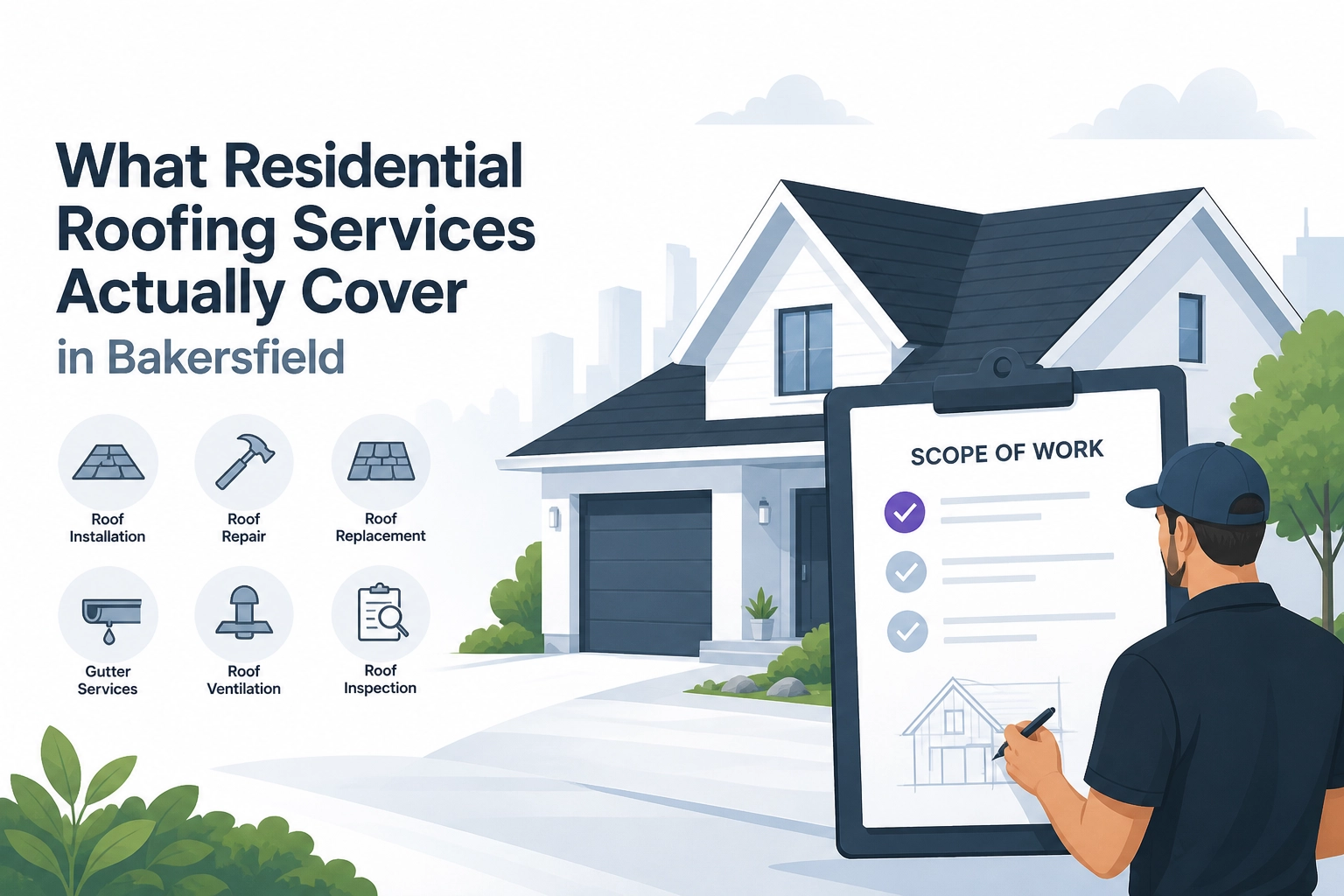
When a roof starts leaking, staining a ceiling, or losing shingles, the phrase residential roofing services can sound like one clear solution. In Bakersfield, that label often hides major differences in scope, price, and disruption. One company may be quoting a full replacement; another may be describing a small repair; a third may only be there to inspect. That confusion makes it hard to know what you are actually buying.
This K-9 guide maps the scope instead of pitching a menu. You will learn why the term residential roofing services is so vague, what counts as roofing work in California, and how five service lines differ: replacement, repair, leak work, inspection, and maintenance. For each one, the post explains what the work includes, what it does not include, and when it is the wrong fit.
You will also see the responsibility split once a job starts. Who handles permits, HOA approval, attic access, landscaping protection, and solar panel removal or reinstallation? Finally, you will learn how to match your roof problem to the right service and why you should get the scope in writing before work begins.
Why Residential Roofing Services Is Such a Vague Label
The phrase "residential roofing services" covers five different jobs: full replacement, spot repair, leak diagnosis, paid inspection, and maintenance. Each has its own scope, cost, and disruption level.
The state's licensing definition stays broad, and it does not divide that work into service lines.
The same ambiguity shows up in commercial roof repair scopes. Two estimates for one ceiling stain can describe two different jobs: one roofer writes a repair, another writes leak work, and you cannot tell which scope you are being sold.
Bakersfield's climate puts real stress on roofs, from heat to drought and fire weather. The right service line depends on what is failing, not the season.
You cannot compare estimates until you know which service your problem belongs to, so identify your service line before you call anyone.
What Counts as Roofing Work in California
California's licensing standard explains why the label stays broad. Under the CSLB's C-39 Roofing Contractor classification, a roofing contractor installs products and repairs surfaces that seal, waterproof, and weatherproof a structure so water does not penetrate and reach material or space beyond. The same definition names the materials and sequence: examine and prepare surfaces, then work with asphaltum, felt, metal roofing systems, shingles, roof tile, slate, urethane foam, and other membrane materials.
What C-39 does not do is split that work into replacement, repair, leak work, inspection, and maintenance. Those five lines are practical distinctions this guide uses to separate scopes, not language from the licensing standard. Because the state defines the category broadly, two licensed contractors can offer different service menus, so get the scope in writing rather than assuming it from a company name.
Before signing anything, confirm the license through the CSLB License Check tool. Confirm it before you sign, and read up on what to expect from roof repair so you know which service your problem belongs to.
Roof Replacement: A Full Tear-Off and Rebuild, Not a Patch
Replacement starts at the deck and ends with a complete roof system. The crew removes existing material down to the deck, inspects and repairs decking, then installs new underlayment, flashing, valleys, and the finished covering. Access, staging, and cleanup are sequenced before the first shingle comes off.
Water-shedding details are part of that assembly, not add-ons. Flashing at walls and penetrations, valley treatment, and edge metal are the parts that fail quietly years later.
What stays outside the scope: interior repair of drywall, insulation, or paint from water damage, which belongs to other trades. Your attic contents and landscaping are excluded beyond access arrangements agreed at the estimate. Ask who handles approval and permitting before you rely on an assumption, and moving solar arrays, satellite dishes, or antennas needs its own line item.
Replacement fits widespread failure; the matching test below covers the specifics, and roof replacement work in Bakersfield is the scope to ask about.
Residential Roofing Repair: Fixing a Known, Localized Defect
Not every problem justifies tearing off the whole system. Residential roofing repair is narrower: it corrects one specific defect you can already identify. The work matches existing materials as closely as possible and seals the repaired area so the fix does not open a new path for water.
What repair excludes matters just as much. It does not include finding the problem for you. Repair is scoped and priced around a known defect, so diagnosis comes first as a separate service. It also does not guarantee the rest of the roof is sound. If the repair exposes decking failing underneath, that becomes replacement or a larger scope, priced separately. Confirm which residential roofing services the repair includes when you review the estimate.
Repair fits when you can point to a known defect; the matching test below covers the rest.
Leak Work: Diagnosing Water Entry Before Fixing It
Repair starts with a defect you can point to. Leak work starts with a question: where is water actually entering? Water can travel along decking and framing before it shows up on your ceiling, and tracing that path is the core of the job.
Diagnosis starts with identifying the failed detail, such as flashing, a penetration, a valley, a fastener, or a compromised underlayment seam. A valley, for example, is a critical runoff pathway and a common failure point. Once the source is confirmed, the work includes correcting it, which is why leak work overlaps with roof repair in Bakersfield, CA but begins from a different question.
Leak work does not include interior restoration of stained drywall, ruined insulation, or damaged ceilings, and it does not include mold remediation. Those are separate trades and separate calls. It also does not promise that no other entry points exist. It addresses the leak you have; a full inspection looks for the ones you do not know about yet.
Leak work fits when water is getting in and the source is not obvious; the matching test below covers the rest.
Roof Inspection: A Condition Assessment, Not a Repair Visit
When a leak diagnosis still leaves you with an aging roof and unanswered questions, the next step is broader. Includes: a documented look at your roof's current condition, covering material, flashing, penetrations, valleys, edge details, drainage, and any accessible deck and attic areas. You receive a written or photographic record you can act on, which makes it useful before a purchase or after a storm.
Does not include: any repair work. Findings become a scope and price only if you authorize the work. It also excludes invasive investigation behind finished surfaces or under materials that must be cut or removed. Destructive testing is a separate scope, agreed before anyone starts cutting. To see what a professional assessment covers, read about what roof inspection services cover.
When it is the right service line: when you have no known defect to point to but want a clear read on condition; the matching test below covers the specifics.
Roof Maintenance: Small Preventative Work on a Schedule
An inspection tells you where your roof stands today. Maintenance is what keeps it there, on a schedule.
This service line is recurring care aimed at small failures before they become leaks. Each visit produces a repeatable record, so you can see whether a condition is stable or getting worse instead of judging from one look.
It does not include repairs, so a maintenance visit does not end in an unexplained invoice. Ask about this at the estimate, before any work is booked. It also does not restore a roof already at the end of its life; maintenance is preventative, not restorative. And it does not cover non-roof items sharing the roof plane, such as HVAC equipment, solar arrays, or skylights, unless those are explicitly included.
Book scheduled roof maintenance in Bakersfield when your roof is in serviceable condition and you want to keep it that way. If it is not, the decision list at the end of this post will point you to the right service line.
The Responsibility Split: What Stays on the Homeowner
Whether you are choosing between repair and replacement or scheduling maintenance, the responsibility split gets confirmed at the estimate stage, not after work starts. Get each answer in writing, because it varies by contractor, contract, and property.
Permits. Ask who pulls the building permit, whether your address requires one, and whether the fee sits in the contract price or arrives as a separate bill. Call the City of Bakersfield building department for your address and keep the answer in writing.
HOA approval. In communities with architectural rules, submittal forms and material or color requirements usually run through you as the owner. Check those rules early; approval timelines can push a start date.
Attic access. Clear a path to the attic hatch and access panels before the crew arrives. Roofers need to see framing and decking from inside, and stored boxes or furniture in the way delay the job.
Landscaping, Solar, and the Rest of the Split
Permits, HOA approval, and attic access are settled. The rest of the split covers your property.
Landscaping and access. Crews need staging space, ladder access, and room to land material and debris. Plants, irrigation heads, and vehicles in the work zone are yours to relocate. Agree in advance on how the crew protects what stays.
Solar arrays. Panels and mounting hardware may need handling around the roof work, and that can sit outside the roofing scope. Confirm in writing who handles each step, who is licensed for it, and who is responsible if equipment is damaged.
Other roof-plane items. Satellite dishes, antennas, swamp coolers, and skylights sit in the work area. Confirm which ones the roofer removes and resets and which need the equipment's own technician.
Around the property. Secure pets, move vehicles out of the driveway and off the work perimeter, and note anything fragile or valuable near the zone.
How to Tell Which Residential Service Your Problem Belongs To
With that split settled, place your own problem in the right service line before you call.
You can point to the damage and the area is small: that is residential roofing repair, and you should be able to name the defect.
Water is coming in and you cannot find the source, or a repair did not stop it: that is leak work, and diagnosis is the first billable step.
Damage is spread across several areas, the roof is old, or you are planning a sale: that is replacement territory, or at minimum an inspection to establish condition first.
You are post-storm, buying a home, or your roof is aging but not leaking: that is an inspection, which should produce a written record you can act on later.
Nothing is broken and you want to keep it that way: that is maintenance.
If you are unsure, ask a residential roofing company to tell you which service line your call falls into before anyone quotes a price. A contractor who cannot or will not draw that line is a signal.
The Takeaway: Get the Scope in Writing Before the Work Starts
Whatever line your problem falls into, the next step is the same. Start with one sentence describing what you see, then place it in a category: replacement, repair, leak work, inspection, or maintenance. Call the wrong one and you will get a quote for work you did not need.
Ask every residential roofing contractor you talk to for two lists, not one: what the service includes and what it does not. The second list is where the surprises live. A company that will not put exclusions in writing is telling you something.
Confirm the responsibility split item by item at the estimate stage: permits, HOA approval, attic access, landscaping and staging, and solar detachment and reinstallation. Get each answer in writing.
Verify the license through the CSLB License Check tool before you sign, and keep the signed scope attached to the contract.
In Bakersfield, K-9 Custom Roofing Inc. works with homeowners and commercial property owners on replacement, repair, leak prevention, installation, and maintenance. Inclusions on any given job are confirmed in the estimate, so ask.
Conclusion
Residential roofing services in Bakersfield cover more than one kind of work. Your problem belongs to a specific service line: replacement, repair, leak work, inspection, or maintenance. The right quote follows the right category.
Your next step is simple. Describe what you see in one sentence, then ask K-9 Custom Roofing Inc. which service line it falls into and confirm inclusions in the estimate. Get the scope in writing, then move forward with confidence.
Frequently asked questions
- Why is the term "residential roofing services" so confusing?
- The phrase covers five different jobs: full replacement, spot repair, leak diagnosis, paid inspection, and maintenance. Each has its own scope, cost, and disruption level, so two estimates for the same problem can describe two different jobs. California's C-39 Roofing Contractor definition is broad and does not divide the work into these service lines.
- What is the difference between roof repair and leak work?
- Repair starts with a known, localized defect you can point to and corrects that defect. Leak work starts with a question: where is water actually entering? It traces the path water takes, identifies the failed detail such as flashing, a penetration, a valley, a fastener, or an underlayment seam, and then corrects that source. Leak work does not include interior restoration or mold remediation.
- When is a full roof replacement the right choice?
- Replacement fits widespread failure. It starts at the deck and includes removing existing material, repairing decking, and installing new underlayment, flashing, valleys, and the finished covering. Interior drywall, insulation, or paint damage from water, and moving solar arrays, satellite dishes, or antennas, are outside the basic scope. Per the post, damage spread across several areas, an old roof, or a planned sale points to replacement, or at minimum an inspection first.
- What does a roof inspection include, and what does it not include?
- An inspection is a documented look at the roof's current condition, covering material, flashing, penetrations, valleys, edge details, drainage, and accessible deck and attic areas. You receive a written or photographic record. It does not include any repair work, and findings become a scope and price only if you authorize the work. Invasive investigation behind finished surfaces is excluded and is a separate, pre-agreed scope.
- What should I confirm about permits, HOA approval, and attic access before work starts?
- Confirm these at the estimate stage and get each answer in writing. Ask who pulls the building permit, whether it is included in the contract price, and check with the City of Bakersfield building department. In HOA communities, approval and material or color requirements usually run through the owner, and approval timelines can affect the start date. Clear a path to the attic hatch and access panels before the crew arrives, since stored items can delay the job.