Commercial Re-Roof Permits and Title 24 in Kern County
Map Kern County commercial re-roof permits, Title 24 cool-roof rules, and inspection holds before demo day so code delays stay out of your budget.
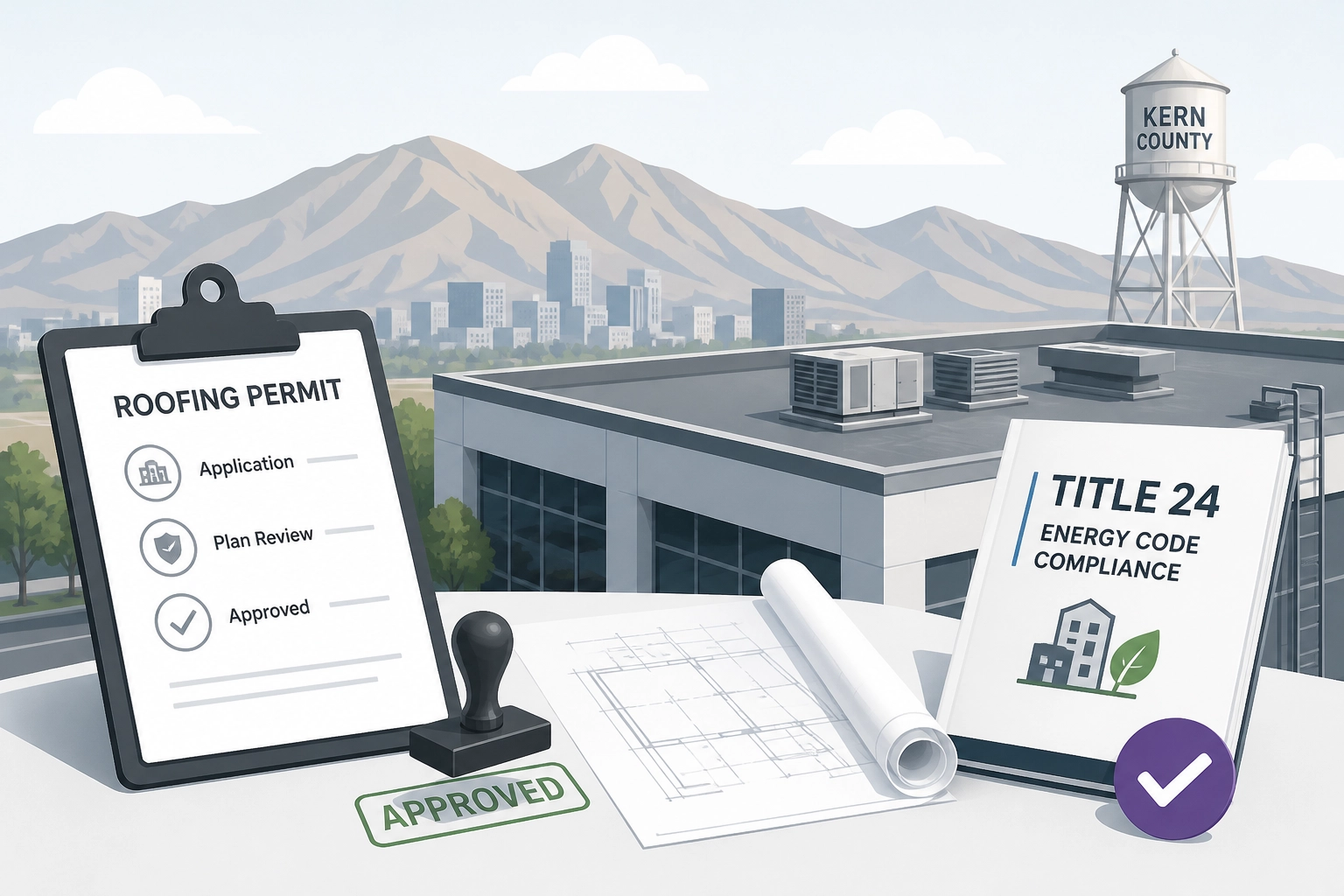
On a Kern County commercial re-roof, the crew is rarely the critical path. The permit and code sequence usually sets the timeline. Before a budget meeting, an owner needs to understand what the county and California require before a roof can be touched, and where those requirements add weeks and dollars to the schedule. This how-to maps that sequence for commercial roofing projects.
You will learn why the code sequence drives the calendar, what to have in hand before applying, how to confirm the code edition and local permit path, and how to test the project against the Title 24 cool-roof threshold. We will cover CRRC-listed products and aged-reflectance documentation, prescriptive versus performance pathways, the exemption question that can change whether a coating escapes the requirement or triggers a fully compliant assembly, and the tear-off and final inspection holds that must be scheduled before materials land. The goal is practical: build a calendar and budget around code, not the crew, and carry a checklist into the meeting that prevents stalled inspections and omitted code-driven upgrades.
Why the Code Sequence Sets the Timeline on a Commercial Re-Roof
The permit and code sequence clears twice: before tear-off and again before final sign-off. Under California's Title 24 energy standards, all new or replacement low-slope roofs must be cool roofs, which makes product selection a compliance decision rather than a finish preference.
Each hold in that sequence, from plan check to the tear-off inspection to final sign-off, sits outside the roofing crew's control. Owners assembling a budget need that order of operations on paper before scope approval, not after material is staged at the curb. How much roof to strip at once is a separate question, addressed in phasing tear-off around tenants.
Two failures cost the most: a stalled inspection with the roof stripped open, and a budget that omitted code-driven upgrades. Both are sequencing failures, not labor failures.
Prerequisites: What to Have in Hand Before the Permit Application
Five items belong in hand before the permit application goes in, and each changes what the county accepts.
1. The governing code edition, in writing. Ask the Kern County Building Department by email which Title 24 edition applies to your application. Published guidance spans a mix of editions, from 2016 handouts through forms revised for 2025 and 2026, so the edition in force for a current permit is never safe to assume.
2. A measured area plan. Show the square footage being replaced, recovered, or recoated, and that number as a percentage of total roof area.
3. The existing assembly, documented. Membrane type, insulation, cover board, deck, and any prior coating. The starting assembly determines which compliance path the roof can claim.
4. The climate zone. California has 16, and steep-slope cool-roof rules vary by zone, as the 2022 Title 24 cool-roof summary shows.
5. Building classification and lease terms. Nonresidential or multifamily, plus work-hour and tenant-notification clauses, all of which land on the calendar.
Request these alongside the documentation your contractor supplies; vetting a commercial roofing contractor covers what else to separate before bids are leveled.
Step 1: Confirm the Code Edition and the Local Permit Path
With those documents in hand, the first step is to pin down the code edition and submittal package by email. Kern County's local amendments rest on the 2019 California Building Standards Code, while published cool-roof guidance spans later editions. Confirm which edition governs your application rather than assuming.
Ask the building department two questions, one of them whether a licensed design professional must prepare the documentation: which code edition applies, and what submittal package a commercial re-roof requires. Separately confirm whether a licensed design professional must prepare the compliance documentation or whether the commercial roofing contractor can complete it.
Request plan-check turnaround and calendar it with a buffer; no published Kern County processing timeline exists to plan against. Before material is ordered, list every inspection type the project will require. Pull the current fee schedule so the permit line item is a real number, not a placeholder.
If the scope is still undecided, commercial roof repair warning signs covers failure points and repair-versus-replace criteria before you commit.
Step 2: Test the Project Against the Title 24 Cool-Roof Threshold
With the code edition confirmed, test scope against the Title 24 cool-roof threshold before bids are leveled. CARB states all new or replacement low-slope roofs in California must be cool roofs under Title 24. For alterations, the prescriptive approach applies when more than 50 percent or 2,000 square feet, whichever is less, of the roof is replaced, recovered, or recoated, subject to exceptions CARB references without enumerating.
Pitched sections are not automatically out; steep-slope cool-roof requirements apply in several of California's 16 climate zones. Run the math on the area actually disturbed, not the original scope. A repair that grows into a recover can cross the threshold mid-job, and the new roofing area then has to meet the cool-roof requirements.
Treat the 50 percent residential threshold as residential only until the county confirms its commercial application. A reflective coating can also raise a scope question: if the county counts it as a recoat, it pulls the roof into the threshold. If a reflective coating is in the conversation, confirm whether it counts as a recoat and pulls the roof into scope, which can change the value case for Bakersfield roof coating options.
Step 3: Specify a CRRC-Listed Product and Document Aged Reflectance
Once the threshold math puts the roof on the prescriptive path, the product becomes a code decision. Title 24 requires roofing products to be tested to CRRC procedures, listed in the CRRC Rated Product Directory, and labeled as CRRC requires; an ENERGY STAR listing alone does not satisfy the standard.
Aged solar reflectance is the compliance value, measured after three years of weathering. Where no aged value is published, the residential fact sheet gives an aging formula with beta at 0.65: an initial reflectance of 0.8 computes to roughly 0.59 aged. Confirm with Kern County before applying that formula to a commercial submittal.
Specify the product by CRRC product ID in the bid and submittal, not marketing name, so the inspected roof matches the certified product.
Field-applied coatings weather differently than factory products, so check the aged value against the requirement rather than the initial number printed on the pail. The same scope question drives residential decisions; our repair versus replacement framework explains it.
Keep the CRRC listing and the manufacturer data sheet in the project file and available on inspection day.
Step 4: Choose Prescriptive or Performance, Then Fix the Paperwork
With the CRRC-listed product and its aged value fixed, the next decision is which compliance path documents it.
Prescriptive means meeting the code's stated values directly. Performance works from a computer energy model, and the responsible person certifies the resulting documentation under penalty of perjury.
Paperwork follows the path. The residential fact sheet names CF1R-ALT-01-E as the certificate of compliance and CF2R-ENV-04-E as the installation certificate for roofing. Commercial equivalents were not confirmed in the sources reviewed, so ask Kern County which forms it accepts. Default aged values published for the performance approach are residential defaults; do not carry them into a commercial submittal without verification.
Whichever path applies, name the responsible party in the contract: who signs the compliance documents, and who delivers them at inspection. If the performance path is selected, budget for a designer or energy consultant. It is a scope item, not a paperwork afterthought. The same discipline carries into structured roof maintenance planning once the roof is in service.
Step 5: Resolve the Exemption Question Before You Price the Job
With the compliance path and paperwork settled, the exemption question is what remains between you and a firm number.
CARB states the prescriptive threshold carries exceptions but does not list them. The list has to come from the code edition in force and from Kern County.
A coating marketed as reflective is not automatically exempt. If it counts as a recoat under the threshold rule, it can pull the roof into the full prescriptive requirement. That is also where how waterproofing coatings behave matters, since a coating sold as a fix is still a regulated roof alteration.
Request the exemption determination before quotes are compared, so every commercial roofing company prices the same scope. If no exemption applies, price the compliant assembly, including any insulation or cover board it requires; those items are frequently absent from initial estimates.
File the determination with the project record. If scope changes during construction, ask again.
Step 6: Schedule the Tear-Off and Final Inspection Holds
Once the exemption question is filed, the next date-driven risk is inspection timing. Tear-off and final inspections each need to be booked before material is ordered. Confirm with Kern County how much advance notice an inspection requires and whether the tear-off inspection must be requested before any new membrane goes down.
Never strip the whole field at once. Sequence tear-off in sections that can be dried in the same day; an open deck is exposure, and Kern County's wind profile makes that exposure real. Stage membrane, insulation, and fasteners on the roof or at the curb before tear-off begins. A material delay over an open deck is the worst version of this failure on any commercial roofing project. As you strip, photograph deck condition, fastener pull-out, and existing insulation. Those photos answer inspection questions without a second visit; a walk-through of how a typical replacement week runs is here.
Owners who want to see how these holds land in practice can read how a Bakersfield replacement week runs. Build the calendar around that sequence, not around the crew.
Step 7: Build the Calendar and the Budget Around Code, Not the Crew
Once inspection holds are on the calendar, build the rest backward from the permit submittal date: plan check, permit issuance, material lead time, tear-off, inspection hold, installation, final inspection.
Budget code-driven line items explicitly: the CRRC-listed cool-roof product upgrade, insulation the assembly triggers, haul-off of the removed roof, permit fees, and design or documentation fees if the performance path applies.
Carry two scenarios to the budget meeting, one where the exemption applies and one where it does not, so the owner can approve either without reopening quotes. Then flag the open-roof day on the same calendar tenants and the property manager use, not just the contractor's schedule. That shared date drives tenant notification, delivery staging, and dry-in sequencing at once.
What to Ask Commercial Roofing Contractors Before Day One
With the calendar mapped, interrogate every bidder before day one. Five questions separate a defensible commercial roofing proposal from a placeholder.
Product and reflectance. Which CRRC product ID does the proposal specify, and what aged solar reflectance does that listing report? A marketing name is not a specification.
Code determinations. Who confirms the code edition, the climate zone, and the compliance form the county will accept? Get the answer in the submittal file.
Permit and inspection responsibility. Who pulls the permit, who schedules the tear-off and final inspections, and what happens to the schedule if an inspection fails?
Tear-off sequencing. How will tear-off be sequenced to limit open-roof exposure, and where will materials be staged? Commercial roofing services differ sharply on this point.
Exclusions. Compare line by line. Deck repair, insulation, curbs, and haul-off are where identical code scope gets priced very differently.
The proposal that answers all five in writing is the one your calendar can survive.
The Checklist You Carry Into the Budget Meeting
Assemble the one-page checklist. It carries three dates: permit submittal, permitted tear-off start, and the final inspection window. If any date is missing from the calendar, the budget is fiction. It carries two numbers: the compliant assembly and the exempt assembly, so the owner can approve either path without restarting the quote process. It carries Kern County's written answers on the code edition in force, the exemption determination, and inspection notice requirements. With those fixed, the crew becomes the schedule, the one part of a re-roof anyone actually controls. K-9 Custom Roofing Inc., a Bakersfield, CA company, serves homeowners and commercial property owners including retail spaces, warehouses, and multi-unit properties with roof replacement, repair, leak prevention, installation, and maintenance.
Conclusion
Commercial re-roofing in Kern County runs on code, not crew availability. Confirm the code edition and permit path first. Test the project against Title 24's cool-roof threshold, then specify a CRRC-listed product and document aged reflectance. Resolve any exemption question before pricing.
Your next step is to request line-item exclusions for deck repair, insulation, curbs, and haul-off. K-9 Custom Roofing Inc. is a Bakersfield, CA company serving homeowners and commercial property owners. Fix the code answers first, and the schedule becomes something you can actually control.
Frequently asked questions
- Why does the permit and code sequence matter more than the roofing crew for a commercial re-roof?
- The permit and code sequence clears twice, before tear-off and again before final sign-off. Each hold, from plan check to the tear-off inspection to final sign-off, sits outside the roofing crew's control, so it usually sets the timeline.
- What should I have ready before submitting a commercial re-roof permit application?
- Five items: the governing code edition confirmed in writing, a measured area plan showing the replaced, recovered, or recoated square footage and its percentage of total roof area, documentation of the existing assembly, the climate zone, and the building classification with any lease terms such as work-hour and tenant-notification clauses.
- How do I confirm which Title 24 code edition applies to my project?
- Ask the Kern County Building Department by email which Title 24 edition applies to your application, and what submittal package a commercial re-roof requires. The post notes that published guidance spans several editions, so the edition in force should not be assumed. Also confirm whether a licensed design professional must prepare the compliance documentation.
- When does the Title 24 cool-roof requirement apply to an alteration?
- CARB states that all new or replacement low-slope roofs in California must be cool roofs. For alterations, the prescriptive approach applies when more than 50 percent or 2,000 square feet, whichever is less, of the roof is replaced, recovered, or recoated, subject to exceptions CARB references without enumerating. Run the math on the area actually disturbed, since a repair that grows into a recover can cross the threshold mid-job.
- What is the difference between a CRRC-listed product and an ENERGY STAR listing for compliance?
- Title 24 requires roofing products to be tested to CRRC procedures, listed in the CRRC Rated Product Directory, and labeled as CRRC requires. An ENERGY STAR listing alone does not satisfy the standard. The post also advises specifying the product by CRRC product ID rather than marketing name, and checking the aged solar reflectance rather than the initial number.